

Choosing the right submersible wastewater pump comes down to matching four key factors to your system: the pump type, the required flow rate and head, the size of solids it must handle, and the available power supply. Get those right and the pump runs efficiently for years; get them wrong and you face clogs, burnouts, or a unit that simply can’t keep up. A submersible pump sits below the liquid level and pushes wastewater upward, so selecting one that fits your exact application is the difference between a reliable system and a recurring headache.
At Wastewater Supply, we help contractors, property owners, and municipalities size pumps correctly every day, and we’ve seen how a careful approach to submersible wastewater pump selection prevents costly mistakes down the road. From single-home effluent pumps to high-capacity municipal grinder units, the same core principles apply.
This guide walks through each factor in plain terms so you can specify the right pump with confidence—or know exactly what to ask when you reach out for help.
The Right Pump Starts with Matching the Type to Your Application
Contents
- 1 The Right Pump Starts with Matching the Type to Your Application
- 2 Flow Rate and Total Dynamic Head Determine the Pump You Need
- 3 Solids-Handling Capacity Protects Your Pump from Clogs
- 4 What Horsepower and Voltage Does Your Pump Require?
- 5 Pump Materials and Build Quality Affect Long-Term Reliability
- 6 Should You Choose an Automatic or Manual Submersible Pump?
- 7 Frequently Asked Questions About Submersible Wastewater Pumps
- 8 Get the Right Pump the First Time
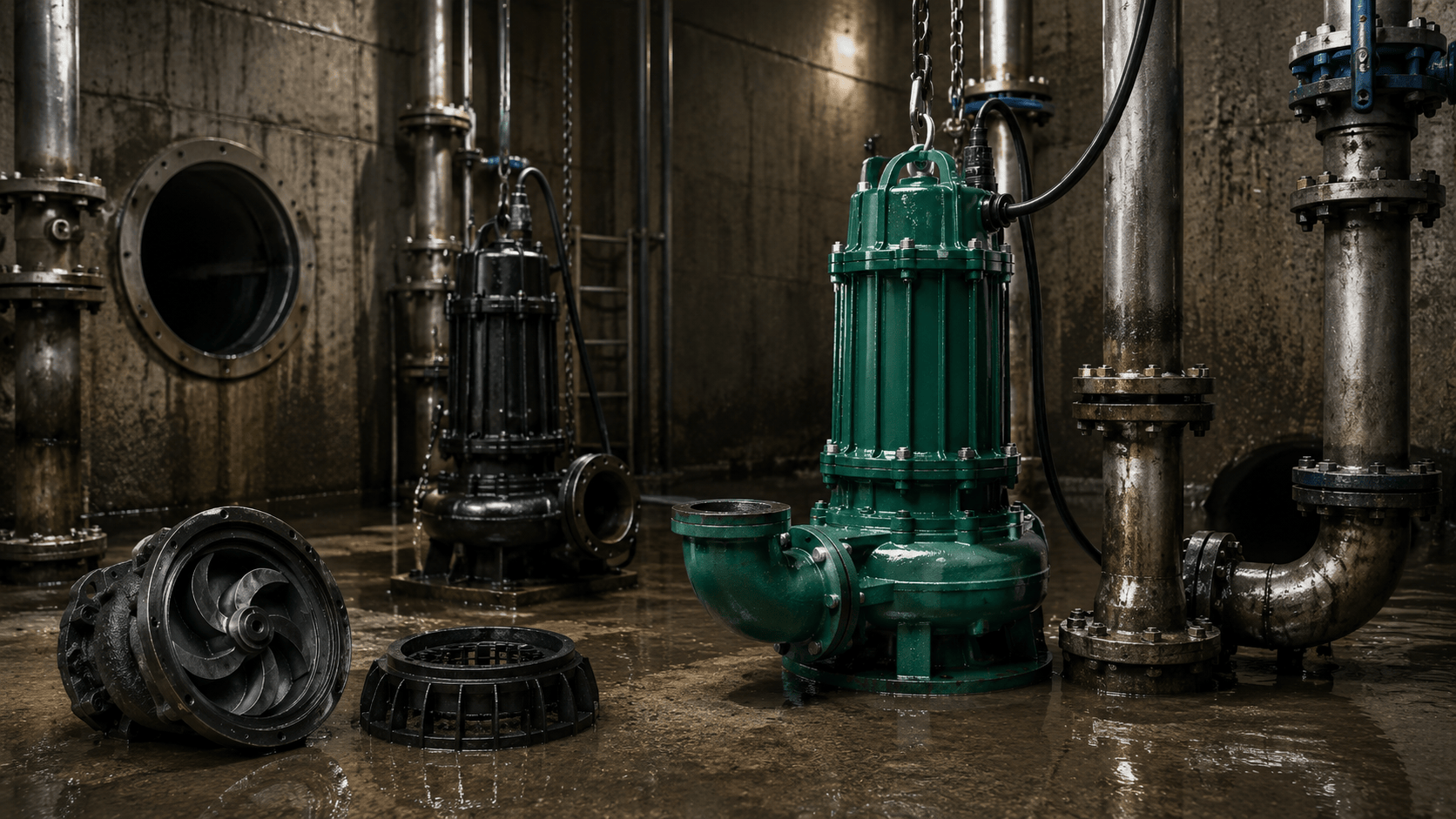
Submersible wastewater pumps are not one-size-fits-all, and the first decision is choosing the type built for your specific waste stream. Using the wrong category—say, a standard sewage pump where a grinder is needed—is one of the most common causes of premature failure. Each pump type is engineered for a particular kind of liquid and solid load.
The main types of submersible wastewater pumps include:
- Sewage pumps — handle raw sewage with soft solids, typically up to 2 inches, in residential and light commercial settings.
- Grinder pumps — shred solids into a slurry before pumping, ideal for long discharge runs or pressurized sewer systems.
- Effluent pumps — move clarified liquid from a septic tank or treatment system; designed for smaller solids.
- Dewatering pumps — remove clean or lightly contaminated water from pits, basins, or construction sites.
Wastewater Supply carries every one of these categories from trusted manufacturers like Zoeller, Liberty Pumps, and Franklin Electric, so you can match the pump precisely to the job rather than forcing a general-purpose unit to do specialized work.
Flow Rate and Total Dynamic Head Determine the Pump You Need
The two most important performance numbers in pump selection are flow rate and total dynamic head, and every submersible pump is rated by how the two work together. Flow rate, measured in gallons per minute (GPM), is how much wastewater the pump must move. Total dynamic head (TDH), measured in feet, is the total resistance the pump must overcome to get the liquid where it needs to go.
Total dynamic head is more than just vertical distance. It combines:
- Static head — the vertical lift from the pump to the discharge point.
- Friction loss — resistance from the pipe length, diameter, fittings, and valves.
- Pressure head — any additional pressure the pump must work against at the discharge.
Every pump has a performance curve showing the GPM it delivers at a given TDH. The goal is to select a pump whose curve meets your required flow at your calculated head without running at the extreme ends of its range. If you’re unsure how to calculate these figures, our team can walk you through it using your system’s specifications.
Solids-Handling Capacity Protects Your Pump from Clogs
A submersible wastewater pump must be able to pass the largest solids in your waste stream, or it will clog repeatedly. Solids-handling capacity refers to the maximum diameter of solid material a pump can move without jamming, and it’s a spec that directly affects reliability. Undersizing here is a frequent and avoidable mistake.
General guidelines for solids handling by application:
- Effluent applications — usually need to pass solids up to about ¾ inch.
- Residential sewage — typically require 2-inch solids handling.
- Commercial and municipal sewage — may need 2.5 inches or larger, or a grinder design.
- Difficult waste with stringy material — often calls for a grinder pump to prevent ragging and clogs.
When waste contains wipes, rags, or other fibrous material, a grinder pump is almost always the safer choice, since it cuts solids down before they can wrap around the impeller.
What Horsepower and Voltage Does Your Pump Require?
The right horsepower and electrical supply must match both your performance needs and the power available at the site. Horsepower should be high enough to meet your flow and head requirements but not so high that the pump is oversized and inefficient. Just as important, the pump’s voltage and phase have to match your existing electrical service.
Key electrical considerations include:
- Horsepower (HP) — driven by your GPM and TDH; let the performance curve guide this rather than guessing.
- Voltage — common options are 115V, 230V, and 460V; confirm what’s available at the installation.
- Phase — single-phase is typical for residential and light commercial; three-phase is common in larger commercial and municipal stations.
- Discharge size — the pump’s discharge must align with your piping, commonly 2 to 4 inches for wastewater.
Matching these specs correctly protects the motor and ensures the pump operates within its rated efficiency. If you’re replacing an existing unit, our team can cross-reference the model to confirm the right electrical match.
Pump Materials and Build Quality Affect Long-Term Reliability
Construction materials determine how long a submersible wastewater pump survives in a corrosive, abrasive environment. Because these pumps sit submerged in sewage around the clock, the housing, impeller, and seals must resist corrosion and wear. Investing in the right build quality up front almost always costs less than frequent replacements.
Materials and features worth evaluating:
- Cast iron housings — the durable industry standard for sewage and grinder pumps.
- Stainless steel components — offer added corrosion resistance for demanding applications.
- Mechanical seals — dual seals provide better protection against motor flooding than single seals.
- Impeller design — non-clog, vortex, and cutter impellers each suit different waste types.
As a stocking distributor for brands like Goulds Water Technology, Tsurumi, Barmesa, and Little Giant, Wastewater Supply can help you weigh build quality against budget so you get a pump that lasts in your specific conditions.
Should You Choose an Automatic or Manual Submersible Pump?
The choice between automatic and manual operation depends on your control setup. An automatic submersible pump includes a built-in float switch that turns the pump on and off based on water level, while a manual pump relies on an external control panel and separate floats. Both are valid—the right one depends on how your system is configured.
Consider these guidelines:
- Automatic pumps — convenient for simple, single-pump residential basins where no separate panel is used.
- Manual pumps — preferred for duplex systems, alarm integration, and applications needing precise level control through a dedicated panel.
For larger or critical systems, a manual pump paired with a properly sized control panel offers the most flexibility and redundancy. Here’s a quick comparison of common pump types to help narrow your choice:
| Pump Type | Best For | Typical Solids Handling |
|---|---|---|
| Effluent pump | Septic/treatment discharge | Up to ¾” |
| Sewage pump | Residential raw sewage | Up to 2″ |
| Grinder pump | Long runs, pressure sewer, fibrous waste | Slurry (shredded) |
| Dewatering pump | Pits, basins, construction water | Small / clean water |
Frequently Asked Questions About Submersible Wastewater Pumps
What’s the difference between a sewage pump and a grinder pump?
A sewage pump moves raw sewage with soft solids intact, typically up to 2 inches, while a grinder pump shreds solids into a fine slurry before pumping. Grinder pumps are the better choice for long discharge runs, pressurized sewer systems, or waste streams with fibrous material like wipes and rags. Sewage pumps are usually more economical for standard residential gravity systems.
How do I calculate total dynamic head?
Total dynamic head is the sum of the vertical lift (static head), the friction loss through your piping and fittings, and any pressure the pump must discharge against. You add these three figures together to get the TDH in feet, then match it against a pump’s performance curve. If you’re not comfortable calculating friction loss, our team can help using your pipe length, diameter, and fitting details.
Can a submersible wastewater pump run continuously?
Most submersible wastewater pumps are designed for intermittent duty, cycling on and off as the basin fills and empties. Some heavy-duty models are rated for continuous operation, but running a standard pump nonstop will shorten its life. Always check the manufacturer’s duty-cycle rating before specifying a pump for high-demand applications.
What size submersible pump do I need for my home?
For most homes, a sewage pump with 2-inch solids handling and a horsepower matched to your flow and head requirements is sufficient. The exact size depends on the number of fixtures, the vertical lift, and the discharge pipe run. Providing these details to our team—or using our pump sizing questionnaire—lets us recommend the correct unit rather than guessing.
How long do submersible wastewater pumps last?
A quality submersible wastewater pump typically lasts 5 to 15 years, depending on duty cycle, water quality, and maintenance. Proper sizing, dual mechanical seals, and corrosion-resistant materials all extend service life. Pumps that are oversized, undersized, or forced to handle the wrong type of waste tend to fail much sooner.
Get the Right Pump the First Time
Choosing the right submersible wastewater pump is a matter of matching the pump type, flow rate, head, solids handling, power supply, and build quality to your specific system—and skipping any one of those steps is where most problems start. When all the specs line up, you get a pump that runs efficiently, resists clogs, and lasts for years.
At Wastewater Supply, our team in Noblesville, Indiana combines decades of industry experience with one of the broadest pump inventories available, so you don’t have to navigate the decision alone. Whether you’re specifying a new installation or replacing an existing unit, reach out or use our pump sizing questionnaire, and we’ll help you select a submersible wastewater pump that’s built for the job—and built to last.
Comments are closed.