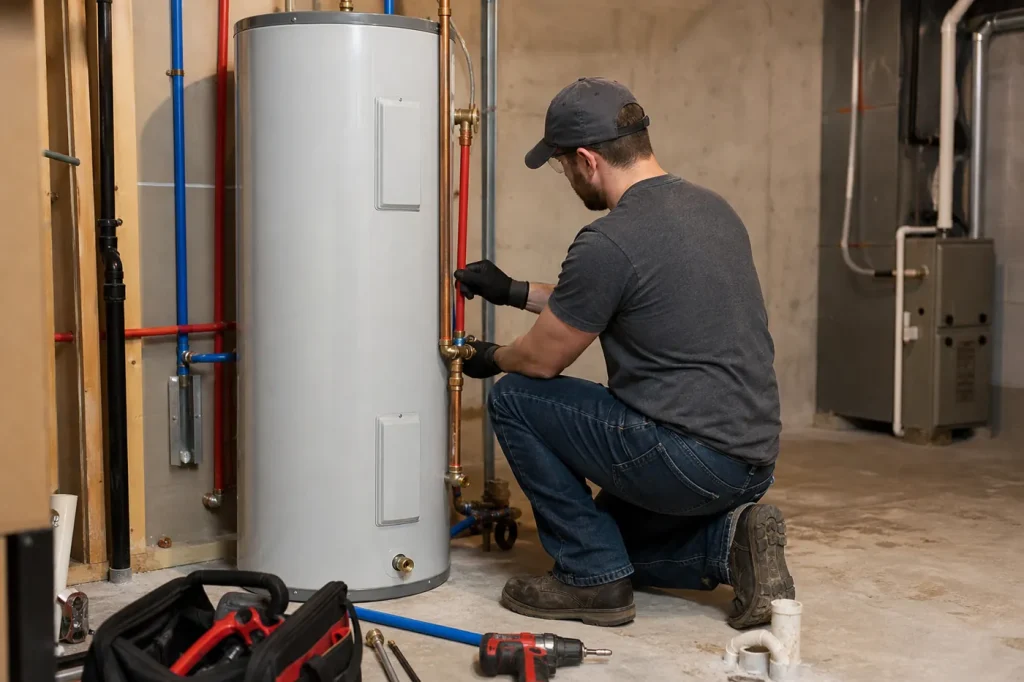
Repair it if the tank is under about 10 years old and the problem is a part. Replace it if the tank itself leaks or it’s 10 to 15+ years old. Consider tankless when you’re replacing anyway, and plan for descaling in Indy’s hard water.
No hot water on a cold Indianapolis morning gets your attention fast. Before you call, it helps to know whether you’re probably looking at a repair, a replacement or a chance to switch to tankless, and why Indy’s hard water matters for all three.
Start with the age
The U.S. Department of Energy says most tank water heaters last about 10 to 15 years, and tankless units can last more than 20. The manufacture date is usually on the label on the side of the tank, sometimes coded into the serial number. If you can’t decode it, a plumber can.
- Under about 10 years old: a repair is often worth it.
- 10 to 15 years old: repairs start to make less sense, especially for anything beyond a simple part.
- Over 15 years old: plan on replacing it before it fails on its own schedule.
Usually a repair
- No hot water or not enough: often a thermostat, heating element (electric), or pilot/igniter (gas)
- Water that turns lukewarm fast: sometimes a broken dip tube or a failing element
- A small leak at a valve or fitting, not the tank itself
- A dripping temperature-and-pressure (T&P) relief valve. Have it checked, because it’s a safety part
Usually a replacement
- Water leaking from the tank itself. Tanks can’t be patched
- Rusty or discolored water from the hot side only
- Loud rumbling or popping on an older unit (heavy sediment)
- Repeated repairs on a tank that’s already 10+ years old
Indianapolis’ hard water is part of the story
Citizens Energy Group’s water quality data puts Indianapolis tap water in the “very hard” range, typically about 12 to 20 grains per gallon. Hard water leaves mineral sediment in the bottom of a tank, which can cause rumbling, slower heating and a shorter life. In a tankless unit, scale builds up inside the heat exchanger.
- Tank heaters: ask about flushing the tank once a year and checking the anode rod.
- Tankless heaters: plan on regular descaling, and ask whether a water softener makes sense for your home.
Tank or tankless?
| Tank | Tankless | |
|---|---|---|
| Typical life (DOE) | About 10 to 15 years | More than 20 years |
| Hot water | Until the tank runs out | On demand, limited by flow rate |
| Upfront cost | Lower | Higher, and may need gas line or venting changes |
| Space | Takes floor space | Wall-mounted, compact |
| Hard water upkeep | Annual flush | Regular descaling |
If your tank still has years left, switching to tankless rarely pays off on its own. It’s worth considering when you’re replacing anyway, you need more hot water at once, or you want the space back.
Safety notes
- If you smell gas near a gas water heater, leave the house and call 911 or your gas utility from outside.
- The Department of Energy suggests setting most water heaters to 120°F to save energy and reduce scalding risk.
- Don’t cap or plug a leaking T&P valve. Call a pro.
What to ask a plumber before you replace
- Will you pull any required permit?
- Is haul-away of the old unit included?
- What’s the warranty on the tank and on your labor?
- Does my home need an expansion tank or other code updates?
- For tankless: will my gas line and venting need upgrades?
Facing a frozen line instead? See frozen pipes in Indianapolis.
Indianapolis plumbers: want your business to be the local expert behind this guide? Get featured.
Sources: U.S. Department of Energy: Energy Saver Guide; Citizens Energy Group: Indianapolis water quality data. Checked November 2026.