
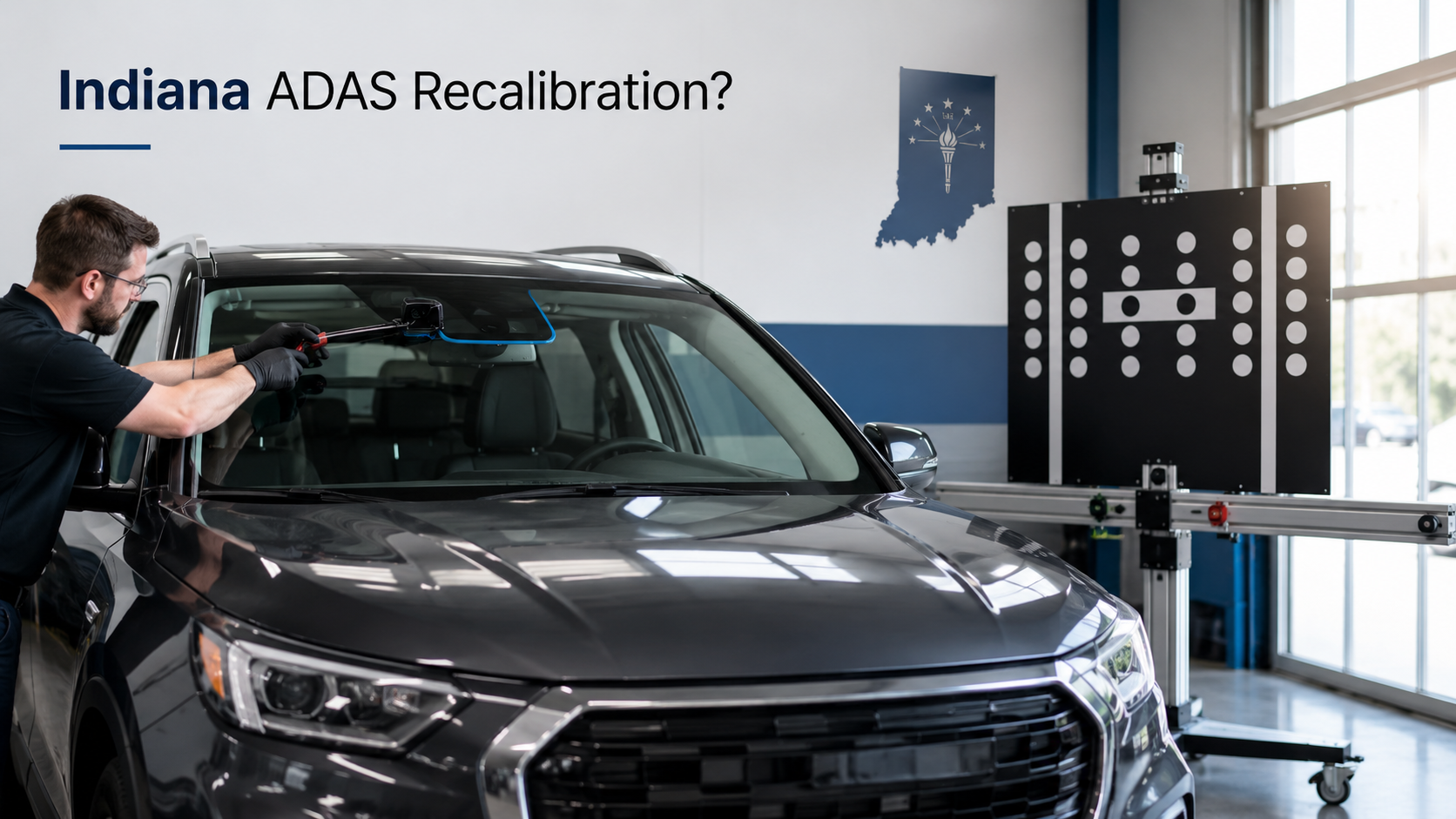

If you drive a vehicle built in the last few years and you just had your glass replaced, there’s a critical step many people don’t know about: recalibrating your car’s safety camera. At Low Price Auto Glass in Hammond, Indiana, we get asked this constantly, so here’s the short answer up front — Indiana does not have a specific state law that forces ADAS recalibration after a windshield replacement, but your vehicle’s manufacturer almost certainly requires it, and skipping it can be both dangerous and legally risky. ADAS recalibration is the process of realigning the cameras and sensors that power features like automatic emergency braking and lane-keep assist after the windshield they’re mounted to is removed and replaced.
Because the rules are easy to misunderstand, we put together a plain-English breakdown of the Indiana ADAS calibration requirements so Hammond drivers know exactly what they’re responsible for. In our experience replacing glass on every make and model that rolls into our shop, the confusion almost always comes from assuming “no state law” means “not required.” It doesn’t. This guide walks through what the law actually says, why your vehicle still needs recalibration, what happens if you skip it, and how the process works.
Indiana Has No Specific Recalibration Law — But Your Vehicle Still Requires It
Contents
- 1 Indiana Has No Specific Recalibration Law — But Your Vehicle Still Requires It
- 2 What ADAS Recalibration Is and Why Your Windshield Controls It
- 3 Does Indiana Require ADAS Recalibration After Windshield Replacement?
- 4 Skipping Recalibration Creates Legal, Insurance, and Safety Risks
- 5 Static vs. Dynamic Calibration: How the Process Works
- 6 How Do You Know If Your Vehicle Needs Recalibration?
- 7 Frequently Asked Questions About Indiana ADAS Recalibration
- 7.1 Is ADAS recalibration legally required in Indiana?
- 7.2 Does insurance cover ADAS recalibration in Indiana?
- 7.3 How much does ADAS recalibration add to a windshield replacement?
- 7.4 Will my dashboard warn me if my ADAS camera is out of alignment?
- 7.5 Can ADAS recalibration be done with mobile windshield service?
- 8 The Bottom Line for Hammond Drivers
Indiana has not passed legislation that specifically mandates ADAS recalibration after windshield replacement. State lawmakers have generally deferred to federal safety standards and original equipment manufacturer (OEM) guidelines rather than writing a dedicated calibration statute, so auto glass work in Indiana falls under general consumer protection law instead of a calibration-specific rule. That’s different from states like New York and Utah, which have enacted detailed auto glass and ADAS notification laws.
Here’s the part that trips people up: the absence of a state law does not make recalibration optional. Nearly every automaker — Toyota, Honda, Ford, Subaru, Tesla, and most others — explicitly requires recalibration of the forward-facing camera whenever the windshield is replaced. When the manufacturer’s published service procedure calls for calibration, that procedure becomes the standard of care a competent shop is expected to follow, regardless of whether the state legislature has written it into code.
- No Indiana statute directly mandates recalibration after glass replacement.
- OEM service requirements do mandate it for the vast majority of late-model vehicles.
- Federal safety guidance from the National Highway Traffic Safety Administration emphasizes that ADAS cameras must be recalibrated after a windshield is replaced.
- General liability law still applies — a shop that ignores the manufacturer’s procedure can be held responsible if a safety system later fails.
What ADAS Recalibration Is and Why Your Windshield Controls It
ADAS stands for Advanced Driver Assistance Systems — the suite of safety technologies that help with lane control, braking, collision warnings, and adaptive cruise control. On most modern vehicles, the forward-facing camera that runs these features is mounted to the inside of the windshield, usually behind the rearview mirror. That mounting location is exactly why glass replacement matters so much.
When we remove your old windshield, the camera assembly comes off with it and gets reinstalled on the new glass. Even a flawless installation can shift the camera’s aim by a fraction of a degree, and these systems are unforgiving about precision. Research shows that a misalignment of just one degree can move the camera’s focal point several feet off-target at highway distances — enough to make the system misread the road. The number of vehicles affected has exploded, too: in 2016 only about one in four vehicles needed calibration after a windshield swap, and today nearly nine out of ten new vehicles do.
Does Indiana Require ADAS Recalibration After Windshield Replacement?
Legally, Indiana does not require it by statute — but practically, your vehicle does, and so does any responsible glass shop following manufacturer specifications. The honest answer is that “required by the state” and “required for your car to be safe and your warranty intact” are two different questions, and only the first one is technically “no” in Indiana.
For drivers in Hammond and across Lake County, the practical takeaway is simple: if your vehicle has a forward-facing camera or driver-assistance features, plan on recalibration as part of the job. A reputable shop will check your specific make, model, and year against the manufacturer’s procedure rather than guessing, because the requirement varies by vehicle.
Skipping Recalibration Creates Legal, Insurance, and Safety Risks
Driving on an uncalibrated ADAS system is what the industry calls a “silent failure” — and it’s the most dangerous misconception we encounter. A misaligned camera usually won’t trigger a dashboard warning light because the system is still electrically functional; it’s simply pointing in the wrong direction. Your automatic emergency braking and lane assist appear to work, but they may not respond correctly when you actually need them.
The risks of skipping recalibration in Indiana fall into three buckets:
- Safety: Misaligned cameras can delay or prevent automatic braking and lane-keeping from engaging properly, undermining the exact systems designed to protect you.
- Insurance: Many insurers now require proof of calibration after a glass claim. Without documentation, you may face complications, reduced payouts, or claim denials.
- Legal liability: If a crash occurs and it’s found that compromised ADAS contributed, the driver — and any shop that ignored manufacturer procedure — can face increased liability.
This is why Low Price Auto Glass treats calibration requirements as part of doing the job correctly, not as an optional upsell.
Static vs. Dynamic Calibration: How the Process Works
ADAS recalibration is handled through two main methods, and some vehicles need one, the other, or both depending on the manufacturer’s procedure. Understanding the difference helps you know why mobile-only service isn’t always possible for newer vehicles.
| Method | How It Works | Conditions Required |
|---|---|---|
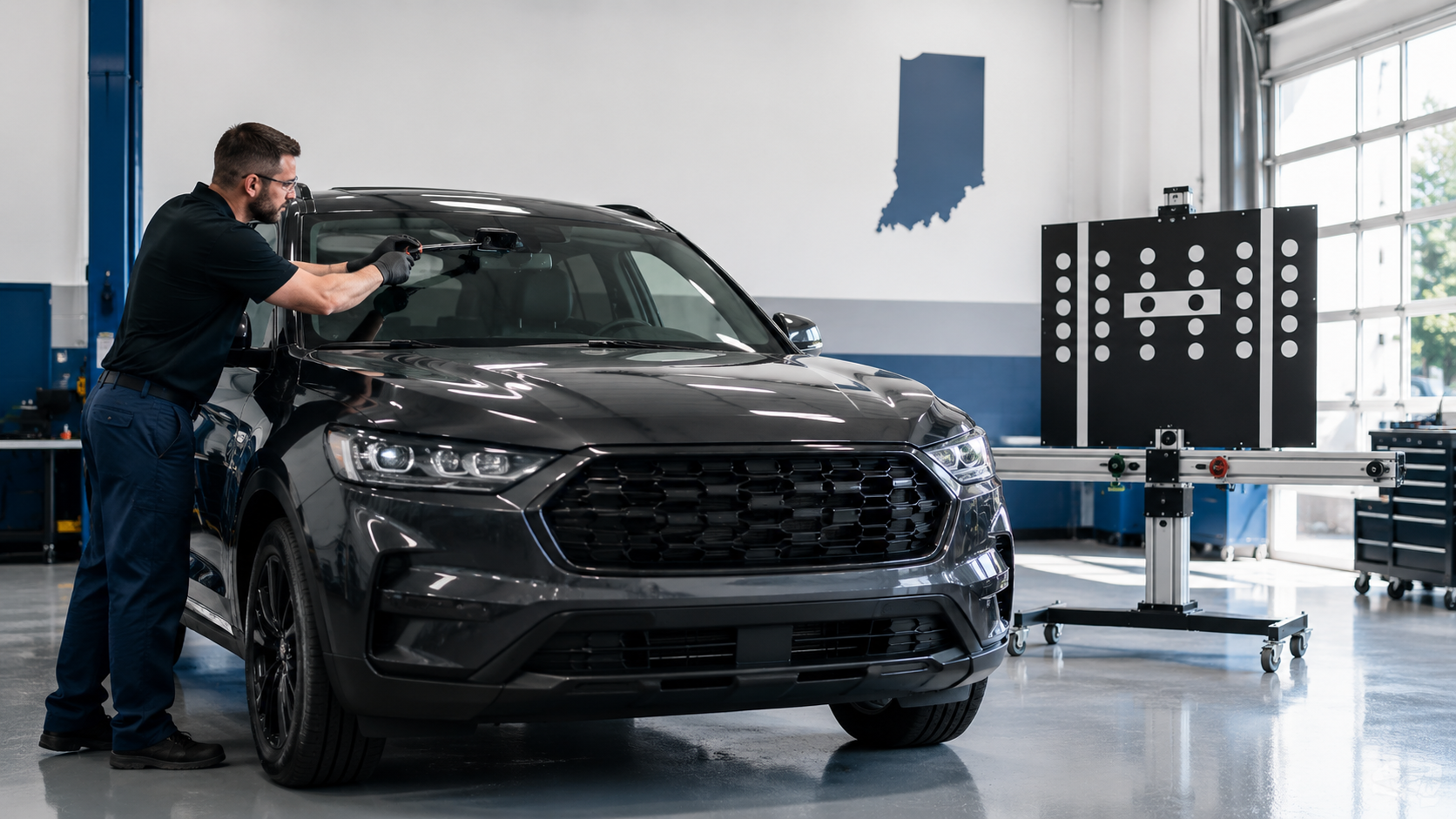
| Static Calibration | Performed in place using targets and charts positioned precisely around the vehicle while specialized equipment aims the camera. | Level floor, controlled lighting, adequate space, diagnostic tools. |
| Dynamic Calibration | The vehicle is driven at a set speed on well-marked roads while the system recalibrates itself in real driving conditions. | Clear road markings, suitable weather, and traffic conditions. |
Most calibrations take roughly one to two hours including system testing and validation. Because static calibration needs a level surface and controlled lighting, recalibration is one area where a quick driveway visit isn’t always enough — the right setup matters.
How Do You Know If Your Vehicle Needs Recalibration?
The most reliable way to know is to have a technician check your exact year, make, and model against the manufacturer’s published requirements. As a quick guide, look near your rearview mirror — if you see a camera housing there, your vehicle very likely relies on a windshield-mounted ADAS camera.
You should expect to discuss recalibration if any of the following apply to your vehicle:
- It’s a recent model year (especially 2020 or newer).
- It has features like lane departure warning, lane-keep assist, adaptive cruise control, or automatic emergency braking.
- There’s a camera or sensor housing mounted behind the rearview mirror.
- You drive a make known for camera-based systems, such as Honda, Toyota, Subaru, Ford, BMW, or Tesla.
Frequently Asked Questions About Indiana ADAS Recalibration
Is ADAS recalibration legally required in Indiana?
There is no specific Indiana state law mandating ADAS recalibration after a windshield replacement. However, vehicle manufacturers require it for most late-model cars, federal safety guidance supports it, and skipping it can expose drivers to liability — so it is effectively required for any vehicle equipped with these systems.
Does insurance cover ADAS recalibration in Indiana?
Many comprehensive and collision policies cover recalibration when it’s performed as part of a windshield replacement. Coverage varies by policy, so it’s worth confirming with your insurer. Keep in mind that some insurers also require documented proof that calibration was completed.
How much does ADAS recalibration add to a windshield replacement?
Cost depends on your vehicle and whether it needs static, dynamic, or both types of calibration. Because pricing varies by make and model, the best approach is to request a quote for your specific vehicle. Many Hammond drivers find that insurance offsets much or all of the calibration cost.
Will my dashboard warn me if my ADAS camera is out of alignment?
Usually not. A misaligned camera often won’t trigger a warning light because the system is still electrically functional — it’s just aimed incorrectly. This “silent failure” is exactly why calibration after glass replacement is so important.
Can ADAS recalibration be done with mobile windshield service?
Sometimes, but not always. Dynamic calibration can often be completed on the road, while static calibration requires a level surface, controlled lighting, and specialized targets. Your technician can tell you which method your vehicle needs before scheduling.
The Bottom Line for Hammond Drivers
Indiana may not have a law on the books naming ADAS recalibration, but that’s a technicality — not a green light to skip it. If your vehicle has a windshield-mounted camera, recalibration is part of getting the job done right, protecting your safety systems, your warranty, and your insurance standing. The smartest move is to work with a shop that checks your vehicle’s manufacturer requirements before the glass even comes out.
At Low Price Auto Glass in Hammond, we work on all makes and models, bill most major insurers, and back our work with a lifetime guarantee for as long as you own your vehicle. If you have a chipped or cracked windshield and you’re not sure whether your car needs recalibration, give us a call at (219) 989-9550 for a free quote — and drive away knowing your safety systems are seeing the road clearly.
Comments are closed.