

A knocked-out tooth is one of the most alarming dental emergencies a parent can face — and in the panic of the moment, it’s easy to do the wrong thing. Whether it’s the right response determines whether your child’s tooth can be saved. Knowing the difference between knocked-out baby tooth vs. permanent tooth care before an emergency happens is one of the most useful pieces of information any parent of a young child can have.
The critical thing to understand upfront is this: the correct response for a knocked-out baby tooth is the complete opposite of the correct response for a knocked-out permanent tooth. Reinserting a baby tooth can cause serious damage to the developing permanent tooth underneath. Failing to reinsert a permanent tooth promptly reduces the chances of saving it dramatically. Knowing which type of tooth came out — and acting accordingly — is everything in these first few minutes.
How to Tell Whether the Knocked-Out Tooth Is a Baby Tooth or a Permanent Tooth
Contents
- 1 How to Tell Whether the Knocked-Out Tooth Is a Baby Tooth or a Permanent Tooth
- 2 A Knocked-Out Baby Tooth Should NOT Be Reinserted — Here’s Why
- 3 A Knocked-Out Permanent Tooth Is a True Dental Emergency — Time Is Everything
- 4 What Happens at the Emergency Dental Appointment for a Knocked-Out Tooth?
- 5 Frequently Asked Questions About Knocked-Out Teeth in Children
- 5.1 My child’s tooth was knocked loose but not completely out — is that a dental emergency?
- 5.2 What if the tooth was swallowed — should I be concerned?
- 5.3 Is there any first aid kit item I should keep at home for dental emergencies?
- 5.4 Can a knocked-out tooth be saved if it dried out completely before reaching the dentist?
- 5.5 How do I reach Czarkowski Pediatric Dentistry in a dental emergency?
- 6 Preparation Is the Best Emergency Response
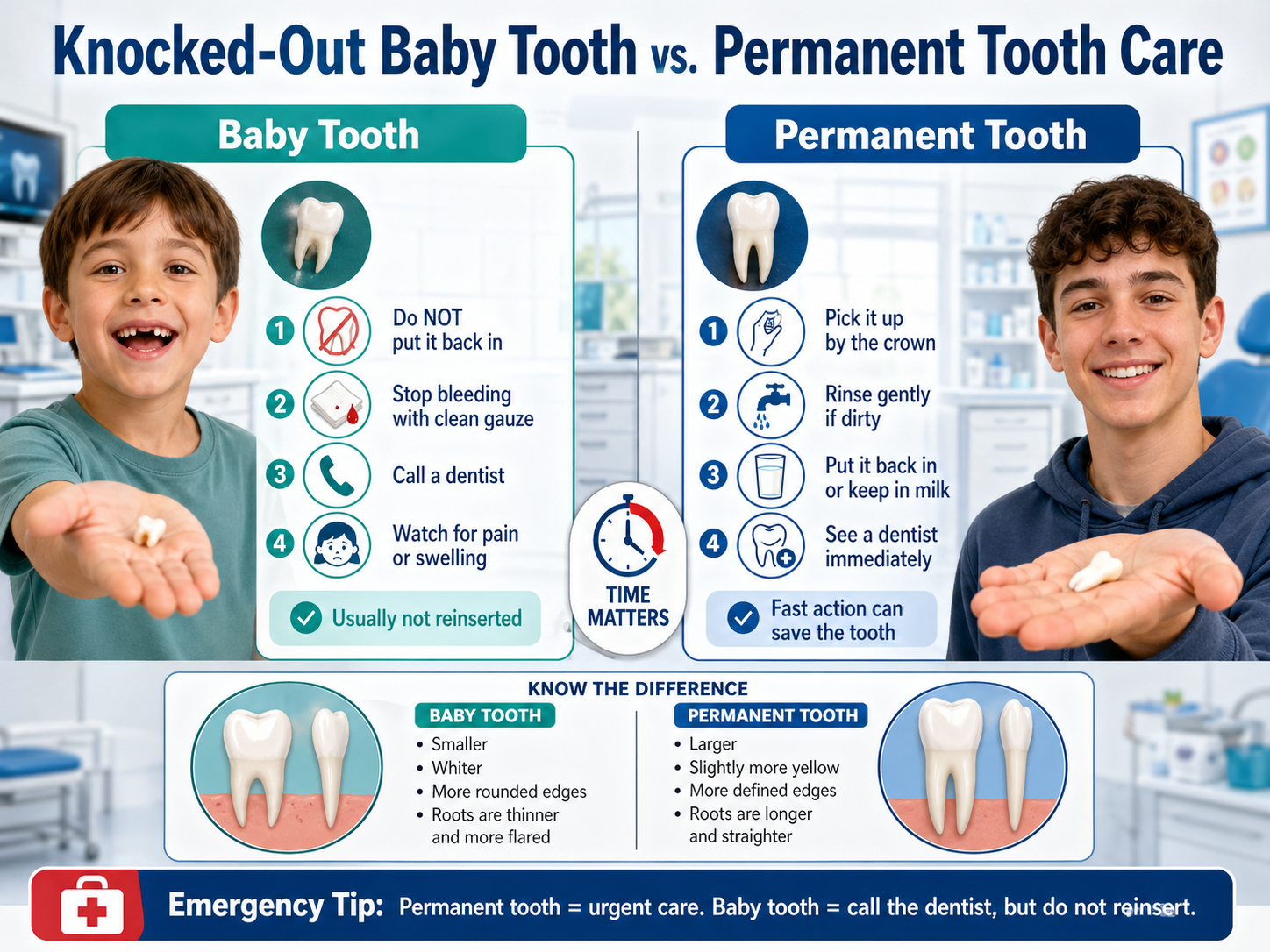
Before you do anything else, identify what type of tooth has been knocked out. This single determination controls every decision that follows. In a stressful moment, here are the fastest ways to tell the difference:
- Size: Baby teeth are noticeably smaller than permanent teeth. A very small tooth — particularly from the front of the mouth — is almost certainly a baby tooth in a child under age 6. By age 7 or 8, the front permanent teeth have usually replaced the baby incisors, so a larger tooth from the front of the mouth in an older child is likely permanent.
- Age of your child: Children typically begin losing baby teeth around age 6, starting with the front incisors, and the process continues until around age 12. If your child is under 6 and a front tooth is knocked out, it is almost certainly a baby tooth. If your child is 7 or older and the knocked-out tooth is a larger, front tooth, it may well be a permanent tooth.
- Root appearance: A baby tooth that was knocked out cleanly will have a shorter, blunter root than a permanent tooth. However, if a baby tooth had already been getting loose naturally, the root may have been partially reabsorbed and appear very short or almost absent — this is normal and not a cause for concern.
- When in doubt, call us: If you genuinely cannot tell which type of tooth it is, call Czarkowski Pediatric Dentistry immediately — even before you leave for the office. Describe your child’s age, which tooth in the mouth it appears to be, and the size of the tooth, and we can help you determine the correct response on the spot.
A Knocked-Out Baby Tooth Should NOT Be Reinserted — Here’s Why
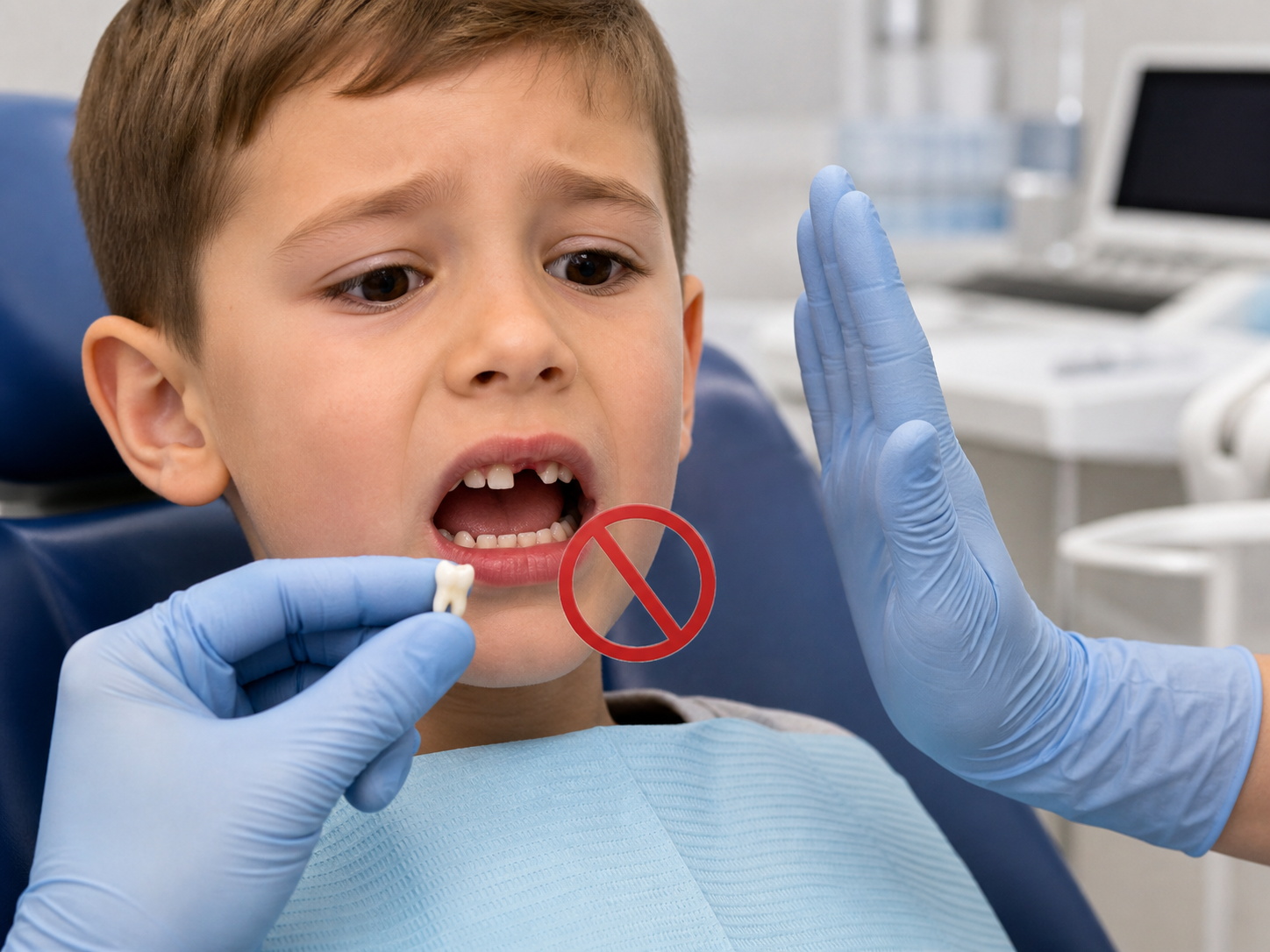
The instinct to put a tooth back where it came from is understandable — but for baby teeth, acting on that instinct can cause serious harm. Underneath every baby tooth is a developing permanent tooth bud, positioned closely below the root of the primary tooth. Forcing a knocked-out baby tooth back into its socket risks pushing it into or against the developing permanent tooth, potentially causing:
- Damage to the permanent tooth crown forming beneath the gum
- Disruption of the permanent tooth’s eruption path
- Staining, malformation, or delayed eruption of the permanent tooth
- Infection transmitted from the traumatized baby tooth socket to the permanent tooth bud
For this reason, the American Academy of Pediatric Dentistry (AAPD) guidelines are clear: do not attempt to reinsert a knocked-out primary (baby) tooth. The tooth is not going to be replanted, and the focus immediately shifts to managing the situation safely and getting your child seen by a pediatric dentist as soon as possible.
What to Do When a Baby Tooth Is Knocked Out
- Stay calm — your child is looking to you for cues. A calm, reassuring response goes a long way.
- Control any bleeding — have your child bite gently on a piece of clean gauze or a folded clean cloth for a few minutes. Minor bleeding from the socket is normal and typically stops on its own.
- Do not place the tooth back in the socket.
- Find the tooth if possible — bring it with you to the appointment so Dr. Kara can confirm it is a baby tooth and assess it for reference.
- Call our office — even if it’s after hours, call and follow the instructions on our after-hours line. We want to see your child to assess the socket, check for injury to surrounding teeth, and confirm that the developing permanent tooth has not been affected.
- Watch for signs of infection in the days that follow — swelling, discoloration, or your child complaining of pain in the area should prompt a follow-up call.
The loss of a baby tooth earlier than expected isn’t always a crisis. Depending on your child’s age and which tooth was lost, Dr. Kara may recommend a space maintainer to prevent the neighboring teeth from drifting into the gap before the permanent tooth is ready to erupt — but this is something we evaluate at the follow-up visit, not an emergency in itself.
A Knocked-Out Permanent Tooth Is a True Dental Emergency — Time Is Everything
A knocked-out permanent tooth — called an avulsed tooth in dental terminology — is a genuine time-critical emergency. Unlike baby teeth, permanent teeth can sometimes be successfully reinserted and saved if the right steps are taken quickly enough. The window for successful reimplantation is narrow: ideally within 30 minutes, though teeth reimplanted within 60 minutes still have a reasonable chance of long-term survival. Beyond 60 minutes, the prognosis for the tooth drops significantly.
The cells on the root surface of the tooth — called periodontal ligament cells — are what determine whether reimplantation succeeds. These cells begin dying almost immediately once the tooth is out of the socket. Keeping those cells alive while you get to the dentist is the entire focus of the steps below.
What to Do When a Permanent Tooth Is Knocked Out
- Find the tooth immediately and pick it up by the crown — the white part — not the root. Touching the root damages the periodontal ligament cells.
- If the tooth is dirty, rinse it gently with milk or saline for no more than 10 seconds. Do not scrub it, wrap it in tissue, or let it dry out. Do not use tap water if milk or saline is available — tap water’s osmolarity is damaging to root cells.
- Reinsert the tooth if possible. If your child is old enough to cooperate and not at risk of swallowing the tooth, gently guide it back into its socket in the correct orientation. Have your child hold it in place by biting gently on a piece of gauze or a clean cloth. This is the best possible storage for the tooth — the socket itself keeps the root cells alive most effectively.
- If reinsertion isn’t possible, store the tooth in milk — this is the best widely available storage medium. Cold milk is preferable. Do not store it in water, do not wrap it in tissue or paper towel, and do not let it dry out. If milk is not available, the tooth can be placed inside the child’s cheek (only if your child is old enough and calm enough not to swallow it) or in a small container of the child’s own saliva.
- Get to a dentist immediately. Call our office on the way — we will be ready for you when you arrive. If the injury occurs outside of office hours, call our after-hours line or go to a pediatric dental emergency provider. Do not wait until the next morning.
What Not to Do with a Knocked-Out Permanent Tooth
- Do not scrub or wipe the root surface — this strips the periodontal ligament cells
- Do not store the tooth in tap water — it damages root cells within minutes
- Do not wrap the tooth in a dry tissue, cloth, or paper towel
- Do not let the tooth dry out — even a few minutes of air exposure begins cell death
- Do not delay getting to a dentist while trying to manage things at home
What Happens at the Emergency Dental Appointment for a Knocked-Out Tooth?
Whether your child has lost a baby tooth or a permanent tooth, a prompt dental visit allows Dr. Kara to fully assess the injury and make sure nothing important has been missed in the chaos of the moment.
For a Knocked-Out Baby Tooth
Dr. Kara will examine the empty socket to confirm the tooth came out cleanly without leaving a fragment, check surrounding teeth for signs of loosening or damage, take an X-ray to confirm the developing permanent tooth has not been displaced or injured, and discuss whether a space maintainer is appropriate given your child’s age and the location of the lost tooth. This appointment is an assessment and prevention visit — not a reimplantation procedure.
For a Knocked-Out Permanent Tooth
If the tooth has been kept moist and you’ve arrived within the critical window, Dr. Kara will attempt reimplantation — carefully repositioning the tooth in its socket and stabilizing it with a splint bonded to the neighboring teeth. The splint is typically left in place for 2 to 4 weeks to allow the tooth to reattach. Follow-up appointments monitor the tooth’s response and may involve additional treatment depending on whether the nerve was affected. Even with prompt, ideal care, reimplanted teeth sometimes require root canal treatment or eventually do not survive long-term — but giving the tooth every possible chance begins with the steps taken in the first few minutes after the injury.
Frequently Asked Questions About Knocked-Out Teeth in Children
My child’s tooth was knocked loose but not completely out — is that a dental emergency?
A loosened or displaced tooth — called a luxated tooth — is also a dental injury that needs prompt professional evaluation, though it is not quite the same emergency as a fully knocked-out tooth. If the tooth is very loose, significantly shifted in position, or your child is in pain, call our office and come in the same day. Do not try to push a displaced tooth back into position yourself. A tooth that has been partially displaced but remains in the socket has a better prognosis than one that has been completely avulsed, and prompt evaluation allows Dr. Kara to stabilize it appropriately.
What if the tooth was swallowed — should I be concerned?
If a tooth — baby or permanent — was swallowed during a fall or collision, it most likely passed into the stomach and will exit the body naturally without causing harm. A tooth that has been inhaled into the airway is a more serious concern: if your child is coughing, having trouble breathing, or appears distressed after the injury, seek emergency medical care immediately rather than coming to the dental office. If you’re unsure whether the tooth was swallowed or inhaled, a chest X-ray can locate it.
Is there any first aid kit item I should keep at home for dental emergencies?
A small bottle of Save-A-Tooth or similar tooth preservation solution (available at many pharmacies) is an excellent item to keep in a home or sports first aid kit — it contains a balanced salt solution that keeps periodontal ligament cells viable longer than milk alone. Beyond that, having gauze on hand and knowing our office’s after-hours number before an emergency occurs is the most practical preparation most families can make.
Can a knocked-out tooth be saved if it dried out completely before reaching the dentist?
A tooth that has been dry for more than 60 minutes has a very poor prognosis for successful reimplantation — the periodontal ligament cells are no longer viable. In some cases, intentional root canal treatment and replantation is still attempted for strategic reasons, with the understanding that the tooth will eventually be lost but may serve a space-maintaining function for a period of time. Dr. Kara will discuss realistic expectations honestly based on the condition of the tooth when it arrives.
How do I reach Czarkowski Pediatric Dentistry in a dental emergency?
Call our office directly at the number on our Contact page. We make every effort to accommodate same-day emergency appointments during office hours, and our after-hours line provides instructions for reaching Dr. Kara when the office is closed. Dental trauma in children is exactly the kind of situation we’re here for — please don’t hesitate to call, even if you’re not sure whether it warrants an emergency visit. We’d always rather hear from you and help you decide than have you wait at home with an injury that needed prompt care.
Preparation Is the Best Emergency Response
No parent wants to think about their child’s tooth getting knocked out — but the families who handle these moments best are the ones who knew what to do before it happened. Save this page. Add our office number to your phone. Keep a tooth preservation kit in your first aid supplies if your child plays contact sports. And if an injury does happen, remember the two rules that matter most: don’t reinsert a baby tooth, and get a permanent tooth back in a moist environment and to our office as fast as you can.
At Czarkowski Pediatric Dentistry, Dr. Kara is here for your child’s dental emergencies — not just their routine checkups. We know how frightening a dental injury can be for both children and parents, and we’ll make sure your child is cared for quickly, calmly, and with as little stress as possible. Save our contact information today so you have it ready if you ever need it.
Comments are closed.